Tesla Stock (TSLA) Climbs to $342: Is the Worst Over After Earnings Crash?

Tesla shares are showing signs of life again. After closing at $342.27 on Friday, August 14 — up $2.31 (+0.68%) — investors are asking whether the electric vehicle giant has finally found a floor after one of its most painful earnings reactions in recent memory. The stock has clawed back roughly 7% from its post-earnings low of $319.69, but questions about profitability, spending, and Elon Musk's ambitious AI bets remain front and center for American shareholders.
For the millions of US investors holding TSLA in their retirement accounts, brokerage portfolios, and 401(k)s, the past month has been a wild ride. Let us break down exactly what happened — and what could come next.
The Earnings Bomb That Shook Wall Street
On July 22, 2026, Tesla reported its second-quarter financial results — and Wall Street was not impressed. While revenue came in strong at $28.24 billion, beating analyst estimates of $26.4 billion, the bottom line was a disaster. Tesla posted adjusted earnings per share of just $0.33, missing the consensus estimate of $0.53 by a staggering 38%.
The market's reaction was swift and brutal. The very next day, TSLA shares cratered 14.5%, closing at $319.69 — the stock's lowest level since August 2025. For a company valued at over $1.35 trillion, that single-day wipeout erased billions in shareholder value and triggered a wave of panic selling across retail brokerage platforms like Robinhood, Fidelity, and Charles Schwab.
Adjusted EBITDA also disappointed, coming in at $3.2 billion versus the $4 billion analysts had projected. The miss raised serious questions about whether Tesla's core auto business is losing pricing power as competition intensifies from Chinese EV makers and traditional automakers ramping up their electric lineups.
The Numbers Behind the Bounce
Despite the earnings shock, Tesla stock has staged a modest recovery over the past three weeks. Here is where things stand as of Friday's close:
- Current Price: $342.27 (+0.68%)
- Day's Range: $335.33 — $351.26
- 52-Week Range: $297.38 — $498.83
- Market Cap: $1.35 Trillion
- Volume: 45.4 million shares (above average)
- YTD Return: +23.89%
- Analyst Price Target: $396.62 (average)
The stock is still down roughly 31% from its 52-week high of $498.83 reached in December 2025, but it has bounced nearly 15% from its July lows near $300. That kind of volatility is nothing new for Tesla — the stock carries a beta of nearly 2.0, meaning it moves roughly twice as much as the broader S&P 500 on any given day.
Robotaxi and AI: Tesla's $25 Billion Bet
One of the biggest concerns weighing on Tesla stock is the company's massive spending on artificial intelligence and autonomous driving. CEO Elon Musk has called 2026 a "massive capex year," with Chief Financial Officer Vaibhav Taneja confirming that capital expenditures will exceed $25 billion this year alone.
That spending is funding three major initiatives:
- Robotaxi Expansion: Tesla's unsupervised Robotaxi service is now operating in seven major US metro areas, including Austin, Dallas, Houston, Miami, Orlando, and Tampa. The Cybercab fleet has logged over 380,000 unsupervised miles. Musk has promised "more than 10% growth in miles driven per week."
- Optimus Robot: Tesla's humanoid robot remains on track for initial production later this year, with early builds being used for training data collection at what the company calls its "Optimus Academy." However, analysts at Morgan Stanley note they are "still looking for evidence beyond commentary" that the robot can deliver real returns.
- Full Self-Driving (FSD): Active FSD subscriptions climbed to 1.48 million, up 56% from a year ago. The company received regulatory approval for FSD (Supervised) in the Netherlands in April, marking a key international milestone.

Breaking News: Sweden Strike Ends After Nearly Three Years
In a major development that could remove a long-standing overhang on Tesla's European operations, Swedish labor union IF Metall announced this week that it is calling off its nearly three-year strike against Tesla, effective August 19, 2026.
The strike, which was the longest in Sweden's history, began after Tesla refused to sign a collective bargaining agreement with the union. Rather than negotiate, Tesla has reportedly offered severance packages to every remaining worker still on strike, effectively buying its way out of the labor dispute. The resolution removes a significant operational and reputational risk that has plagued Tesla's Scandinavian operations since 2023.
For US investors, the end of the Sweden strike is welcome news. Labor peace in Europe allows Tesla to refocus on production and delivery growth in one of its most important international markets.
What Wall Street Is Saying Now
Analyst sentiment on Tesla remains deeply divided. Morgan Stanley, one of the most closely followed firms on Wall Street, maintains a Hold rating on the stock with a $415 price target. Analyst Andrew Percoco wrote in a recent note that while Tesla's long-term AI positioning remains strong, investors need "clearer evidence that Robotaxi is scaling and more tangible Optimus proof points to support the ROI on elevated capex."
Meanwhile, Stifel maintains a Buy rating but recently lowered its price target from $508 to $491, citing near-term challenges including tariffs and the potential loss of EV tax credits under shifting US policy.
The consensus among 49 analysts covering Tesla breaks down as follows:
- Buy / Strong Buy: 45%
- Hold: 43%
- Sell / Underperform: 12%
The average analyst price target of $396.62 implies roughly 16% upside from current levels — though Tesla has a history of making analysts look foolish with its wild price swings.
The Technical Picture: What the Charts Say
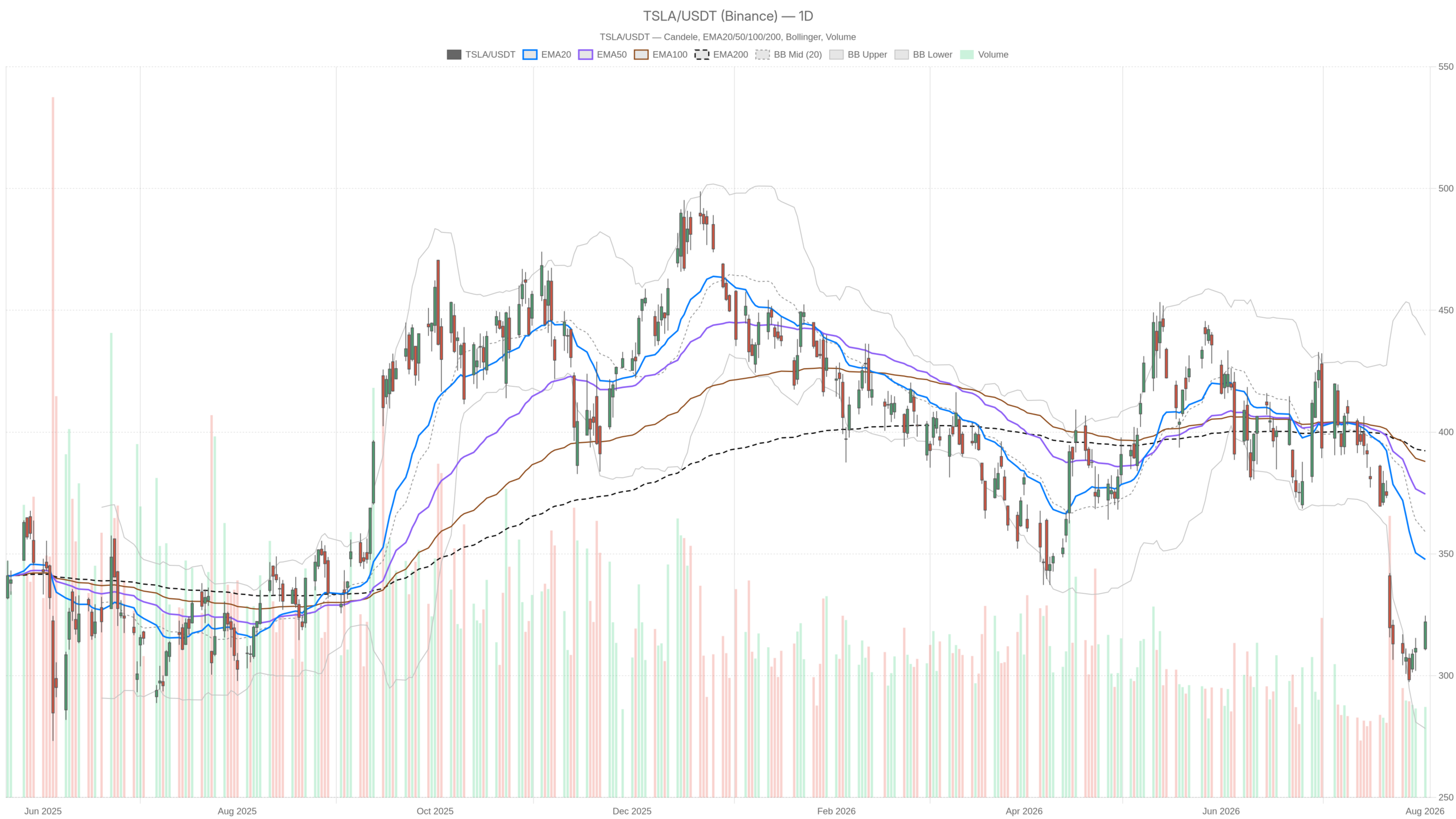
From a technical analysis standpoint, Tesla stock is at a critical juncture. The daily chart shows the stock attempting to form a base after the sharp July decline. Key levels US traders are watching:
- Resistance: $351 (Friday's high) and $360-$380 (gap fill zone from earnings)
- Support: $335 (Friday's low) and $320 (post-earnings low)
- Breakdown Risk: Below $319 could open the door to retest the 52-week low of $297
The MACD indicator on the daily chart is beginning to show early signs of a bullish crossover, while the RSI has climbed out of oversold territory but remains neutral. TradingView's technical analysis currently rates TSLA as a sell on the daily timeframe but neutral on the monthly view — suggesting the short-term pain may be easing even if the long-term trend remains uncertain.
What to Watch Next
Tesla's next major catalyst is its third-quarter earnings report, scheduled for October 21, 2026. Analysts are currently expecting EPS of $0.46 on revenue of approximately $27.66 billion. Whether Tesla can beat those estimates — and provide clearer guidance on Robotaxi scaling and Optimus production — will likely determine whether the stock can reclaim the $400 level or slide back toward $300.
Other key events on the horizon:
- Project Crystal Sun: Tesla's proposed $10.1 billion vertically integrated solar cell factory in Texas
- Elon Musk's Pay Package: Ongoing discussions about Musk's controversial compensation plan, which requires Tesla to reach an $8.5 trillion market cap to fully vest
- EV Tax Credit Policy: Potential changes to federal EV incentives under the current administration
Frequently Asked Questions
What is Tesla's stock price today?
As of August 14, 2026, Tesla (TSLA) closed at $342.27, up $2.31 (+0.68%). After-hours trading saw the stock slip slightly to $341.65.
Why did Tesla stock drop in July 2026?
Tesla stock fell 14.5% on July 23 after reporting Q2 2026 earnings that missed analyst expectations. EPS came in at $0.33 versus the $0.53 estimate — a 38% miss.
Is Tesla a buy, hold, or sell right now?
Wall Street is divided. About 45% of analysts rate TSLA a Buy, 43% say Hold, and 12% recommend Sell. The average price target is $396.62, suggesting potential upside from current levels.
When is Tesla's next earnings report?
Tesla is scheduled to report Q3 2026 earnings on October 21, 2026. Analysts expect EPS of $0.46.
What is Tesla's Robotaxi progress?
Tesla's unsupervised Robotaxi service operates in seven US cities with over 380,000 autonomous miles logged. The company plans rapid weekly expansion.
Bottom Line for US Investors
Tesla at $342 is neither cheap nor expensive by historical standards — it is simply Tesla being Tesla. The stock remains a high-conviction, high-volatility bet on the future of electric vehicles, autonomous driving, and robotics. For long-term investors with strong stomachs, the current price may represent a reasonable entry point. For risk-averse traders, waiting for clearer proof that Robotaxi and Optimus can deliver real revenue may be the wiser move.
One thing is certain: with Elon Musk at the helm, Tesla will never be boring.
Are you buying, holding, or selling TSLA right now? Share your strategy in the comments below.
Topics: Tesla Stock TSLA, Tesla Stock Price Today, TSLA Stock Analysis, Tesla Earnings 2026, Tesla Robotaxi, Tesla Cybercab, Elon Musk, NASDAQ TSLA, Tesla Sweden Strike, Tesla Stock Forecast, EV Stocks, Tech Stocks


Comments
Post a Comment