NVIDIA Stock Crashes to $217 Despite Smashing Earnings: The Beat-and-Raise Curse Continues
Published: August 29, 2026 | Reading Time: 8 min | Market Analysis

In what is becoming one of the most frustrating patterns on Wall Street, NVIDIA Corporation did everything right — and got punished anyway. On Wednesday, August 26, 2026, the world's most valuable semiconductor company reported fiscal second-quarter earnings that demolished analyst expectations. Revenue came in at a staggering $96.2 billion. Earnings per share hit $2.22. Data Center sales surged 116.6% year-over-year to a record $89.02 billion. Guidance for the next quarter was raised to $108 billion, well above the $104 billion consensus.
And yet, by the close of trading on Thursday, August 28, NVIDIA stock sat at $217.55 — down $10.43 (-4.57%) on the day and roughly 8% below its 52-week high of $236.54. For the millions of American investors holding NVDA in their brokerage accounts, retirement funds, and index portfolios, the message from the market is deafening: Being perfect is no longer good enough.
This is not a new story. It is the fifth consecutive quarter that NVIDIA has beaten Wall Street's estimates on both revenue and earnings — and seen its stock price fall in the trading session following the report. The phenomenon has a name on trading desks: the NVIDIA beat-and-raise curse.
The Numbers That Should Have Sent NVDA to the Moon
Let us start with the facts, because the scale of NVIDIA's quarterly performance is genuinely breathtaking. For the three months ended July 26, 2026, the company reported:
- Revenue: $96.2 billion (up 106% year-over-year, vs. analyst estimates of ~$92.2 billion)
- Adjusted EPS: $2.22 (up 111.4% year-over-year, vs. estimates of ~$2.08-$2.09)
- GAAP Gross Margin: 75.0% (vs. 72.7% in the year-ago quarter)
- Data Center Revenue: $89.02 billion (up 116.6% YoY, up 18.3% QoQ)
- Hyperscale Revenue: $48.71 billion (up 101.5% YoY)
- Free Cash Flow: $48.5 billion in the quarter
The guidance was equally impressive. Management forecast fiscal third-quarter revenue of $108 billion, plus or minus 2%, representing year-over-year growth of approximately 89% from the $57 billion reported in Q3 fiscal 2026. Gross margin guidance was set at 74.0%, compared to 73.6% in the year-ago period.
CEO Jensen Huang was characteristically bullish on the earnings call. "AI has reached its inflection point. It is doing useful work. Its tokens are productive and profitable. Now, compute is revenue," he declared. "And demand is accelerating. The AI infrastructure buildout is at full steam."
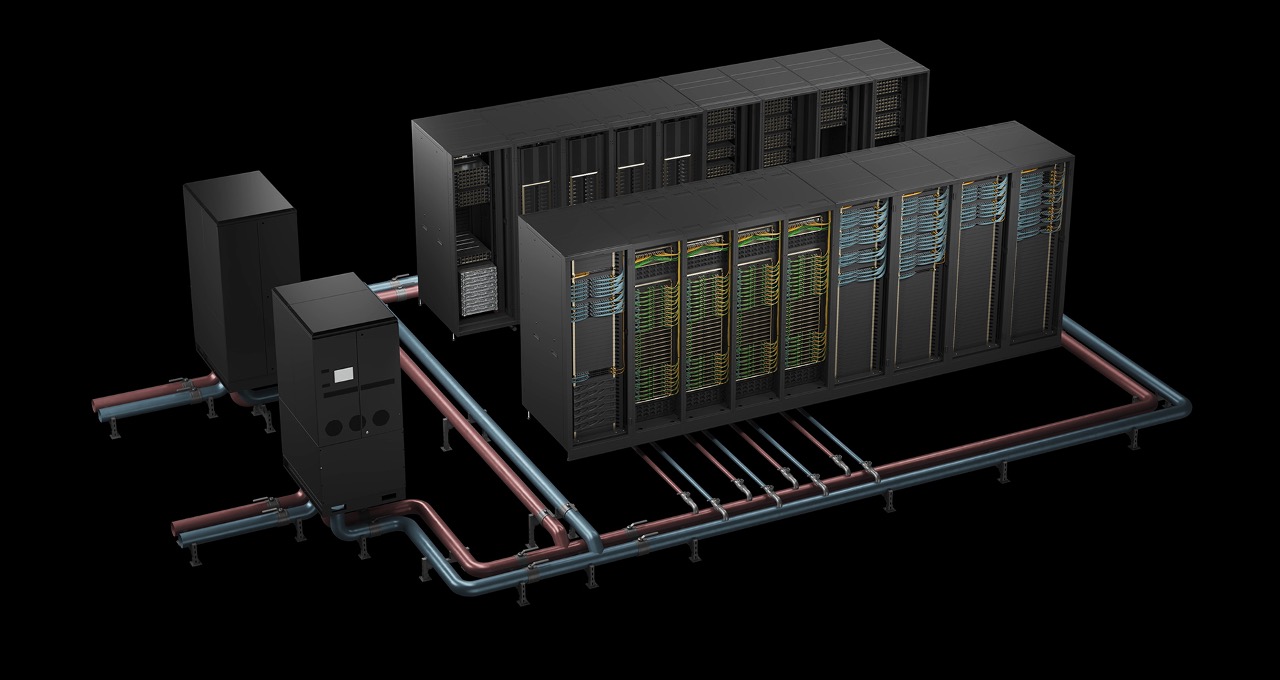
CFO Colette Kress added that the record Data Center performance was "driven by the ramp of our Blackwell Ultra infrastructure," with hyperscale revenue climbing on the strength of the new architecture. ACIE — AI Clouds, Industrial, and Enterprise — grew an even faster 138.1% year-over-year to $40.31 billion.
So Why Did the Stock Crash?
If the numbers were this good, why did NVIDIA shares shed more than $50 billion in market capitalization in the two days following the report? The answer lies in a dangerous cocktail of sky-high expectations, mechanical market forces, and growing investor fatigue.
1. The Bar Was Set Impossibly High
NVIDIA has beaten analyst estimates in 10 of the last 11 quarters by an average of nearly $0.06 per share. The market has come to expect perfection. When the company "only" beat revenue by roughly 4% and EPS by roughly 6%, traders treated it as a disappointment. As Wedbush analyst Matt Bryson noted, NVIDIA has "consistently exceeded consensus the last three quarters, yet the stock is roughly unchanged from October of last year."
2. The Fifth Straight Post-Earnings Decline
History has become NVIDIA's enemy. Over the past eight quarters, the stock has declined on the trading day following earnings in six of them:
- Q1 FY2027 (May 2026): -1.8%
- Q4 FY2026 (Feb 2026): -5.5%
- Q3 FY2026 (Nov 2025): -3.2%
- Q2 FY2026 (Aug 2025): -0.8%
- Q4 FY2025 (Jan 2025): -8.5%
This pattern has created a self-fulfilling prophecy. Algorithmic traders, hedge funds, and options dealers now position for a drop going into earnings, which mechanically suppresses the share price regardless of the underlying results.
3. Options Market Mechanics
According to derivatives analysts, heavily concentrated short-dated options positioning around key strikes created a gamma squeeze heading into the report. With call volume of over 886,000 contracts in the August 28 expiration alone, dealers were forced to sell shares to hedge their exposure as the stock moved — amplifying the decline. The options market had priced in a 5.4% swing in either direction, implying roughly $280 billion of market cap was on the line.
4. The "Law of Large Numbers" Fear
Even with 106% revenue growth, some investors worry that NVIDIA is simply too big to keep growing at this pace. Annual revenue has exploded from $27 billion in FY2023 to $216 billion in FY2026 — an 8x increase in just three years. Skeptics ask: How long can a half-trillion-dollar revenue run rate keep doubling?
Breaking Down the Stock's Wild Three-Day Ride
The price action around NVIDIA's earnings was a masterclass in volatility. Here is how it played out for US investors:
Tuesday, August 26 (Earnings Day): NVDA opened at $212.46 and traded in a tight range ahead of the 4:00 p.m. EDT report. The stock closed regular hours at $209.66, down roughly 1% as traders positioned defensively. When the earnings numbers hit the wire, the stock initially ticked up in after-hours trading — then reversed sharply lower, falling as much as 1.3% as management began its conference call.
Wednesday, August 27: In a dramatic reversal, NVDA surged +8.7% to close at $227.98. Buyers flooded in, interpreting the beat-and-raise as confirmation that the AI trade remains intact. Volume exploded to nearly 300 million shares — more than double the daily average — as institutional investors who had sold ahead of earnings bought back in.
Thursday, August 28: The rally collapsed. NVDA opened at $227.33, briefly touched a high of $229.26, then sold off relentlessly throughout the session. The stock closed at $217.55, down $10.43 (-4.57%). Volume remained elevated at 194 million shares, well above the 139 million average, indicating that large players were actively reducing exposure.
The three-day sequence — down, up big, down big — left many retail investors dizzy and questioning whether the stock has become too volatile for long-term portfolios.
Where NVDA Stands Now: Key Metrics
As of the August 28 close, here is the complete picture for NVIDIA shareholders:
- Current Price: $217.55
- Previous Close: $227.98
- Day's Range: $216.82 — $229.26
- 52-Week Range: $164.07 — $236.54
- Market Cap: $5.25 Trillion
- P/E Ratio (TTM): 27.50
- Forward P/E: ~21x
- EPS (TTM): $7.91
- Beta: 2.21
- Volume: 194 million (vs. 139 million average)
- Dividend: $0.25 quarterly (ex-date: September 10, 2026)
- Analyst Price Target: $305.79 (average)
At roughly 21 times forward earnings, NVIDIA is trading at approximately the same valuation as the broader S&P 500 — a remarkable fact for a company growing revenue at over 100% annually. Bank of America analyst Vivek Arya has argued that NVDA could be trading at a valuation discount of up to 50% relative to its AI peers, with a price target of $350.
The Blackwell and Rubin Roadmap: Why Bulls Remain Confident
Despite the post-earnings selling, the long-term bull case for NVIDIA remains as compelling as ever. The company has disclosed visibility into approximately $500 billion in cumulative revenue for its Blackwell and Rubin products from the start of calendar 2025 through the end of calendar 2026. Supply-related purchase commitments have surged to $119 billion — essentially a booked backlog that stretches years into the future.
The Blackwell Ultra architecture is now ramping at full speed and has been deployed across all major cloud providers. Networking revenue within the Data Center segment hit $11 billion in the most recent quarter, more than 3.5 times the prior year. The next-generation Vera Rubin processors are on track for shipment later this year, with Rubin Ultra expected in 2027 and Feynman in 2028.
CEO Jensen Huang believes there will be $3 trillion to $4 trillion in global AI factory buildout annually by the end of the decade. The four largest hyperscalers — Microsoft, Amazon, Meta, and Google — are projected to spend a combined $700 billion on capital expenditures in 2026, the vast majority flowing into AI infrastructure powered by NVIDIA chips.
Recent partnerships underscore the scale of demand. NVIDIA's collaboration with OpenAI and SB Energy involves a $105 billion credit backstop for AI infrastructure. The company also announced a $1 billion AI infrastructure agreement with South Korean tech giant Naver and is building AI supercomputers across France, Germany, Italy, Spain, and the United Kingdom.
The China Risk and Custom Silicon Threat
No discussion of NVIDIA's future is complete without addressing the two biggest risks hanging over the stock.
China Export Restrictions: US government sanctions have blocked NVIDIA from selling its most advanced AI chips to Chinese customers. The company shipped zero H20 units to China in the first quarter and has guided with no China Data Center revenue baked in. The good news: NVIDIA still beat estimates with China at zero. The bad news: any relaxation of sanctions could provide upside, while further tightening would pressure margins.
Custom Silicon Competition: Perhaps the more serious long-term threat is the rise of in-house AI chips from NVIDIA's own customers. Google has its TPUs. Amazon has Trainium. Microsoft has Maia. And on August 25, just one day before NVIDIA's earnings, OpenAI disclosed a newly benchmarked custom chip — a direct shot across NVIDIA's bow. While these alternatives are not yet competitive with NVIDIA's full-stack solution, they represent a multi-year structural risk to pricing power and market share.
Additionally, AMD is gaining share in inference workloads, and several model labs are exploring ways to reduce their dependence on NVIDIA's CUDA ecosystem. The company is not invincible — even if it currently has no equal.
Technical Analysis: Key Levels to Watch
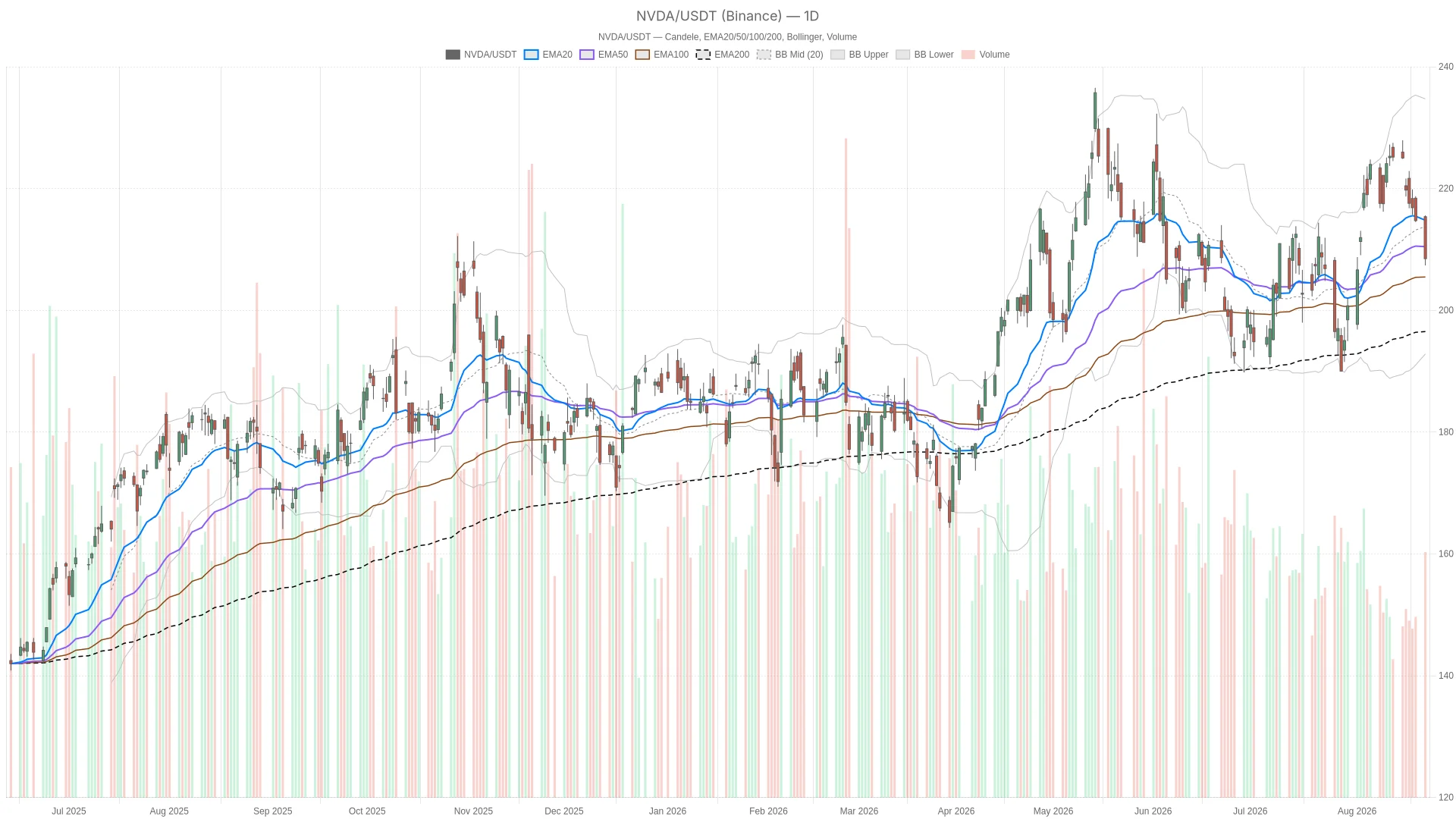
From a technical standpoint, NVIDIA stock is at a critical inflection point. The daily chart shows a violent whipsaw around the earnings report, leaving the stock in a precarious position. Key levels US traders are monitoring:
- Immediate Resistance: $220 (psychological) and $228-$230 (post-earnings high)
- Major Resistance: $236.54 (52-week high)
- Support: $212 (August lows) and $210 (200-day moving average zone)
- Breakdown Risk: Below $210 could trigger algorithmic selling toward $200, with Seeking Alpha analyst Michael Kramer identifying $190 as critical technical and options-related support
The MACD indicator on the daily chart remains in negative territory after the sharp August decline, while the RSI has fallen back toward neutral. TradingView's technical summary currently rates NVDA as a neutral-to-sell on the daily timeframe. The stock's beta of 2.21 means it moves more than twice as much as the S&P 500 on any given day — a feature that rewards brave traders and punishes nervous holders.
What Wall Street Is Saying Now
Analyst sentiment remains overwhelmingly positive, even if the stock price disagrees. The consensus among 49 covering analysts breaks down as follows:
- Buy / Strong Buy: 65%
- Hold: 30%
- Sell / Underperform: 5%
The average analyst price target of $305.79 implies roughly 40% upside from current levels. Notable targets include:
- Bank of America: $350 (Vivek Arya)
- Wedbush: $330 (Matt Bryson)
- Morningstar: $225 fair value estimate
Even the prediction markets are betting on a rebound. Polymarket currently implies a 95.3% probability that NVIDIA will continue beating earnings estimates in future quarters. The question is no longer whether NVIDIA can grow — it is whether the stock price will ever reflect that growth.
The Dividend and Capital Return Story
For income-oriented American investors, NVIDIA has become increasingly shareholder-friendly. The company recently:
- Raised its quarterly dividend from $0.01 to $0.25 per share, with the next ex-dividend date set for September 10, 2026
- Authorized an additional $80 billion in share buybacks, on top of $38.5 billion remaining from previous authorizations
- Generated $48.5 billion in free cash flow in a single quarter
With a dividend yield of approximately 0.44% and a payout that is growing rapidly, NVIDIA is evolving from a pure growth stock into a hybrid growth-and-income play. The $80 billion buyback authorization alone represents roughly 1.5% of the company's market cap — a meaningful return of capital that should provide a floor under the stock during periods of weakness.
Frequently Asked Questions
What were NVIDIA's Q2 FY2027 earnings results?
NVIDIA reported revenue of $96.2 billion (up 106% YoY) and adjusted EPS of $2.22 (up 111% YoY), both beating analyst estimates. Data Center revenue hit a record $89.02 billion.
Why did NVIDIA stock drop after beating earnings?
Despite beating estimates, NVDA fell due to a combination of sky-high expectations already priced in, options market mechanics, algorithmic selling, and a historical pattern of post-earnings declines. The stock has now dropped after 5 of the last 6 earnings reports.
What is NVIDIA's stock price today?
As of August 28, 2026, NVIDIA (NVDA) closed at $217.55, down $10.43 (-4.57%). After-hours trading saw the stock at $217.89. The 52-week range is $164.07 to $236.54.
What is NVIDIA's guidance for next quarter?
Management guided Q3 FY2027 revenue to $108 billion (plus or minus 2%), representing approximately 89% year-over-year growth and well above the $104 billion consensus estimate.
Is NVIDIA stock a buy at $217?
Wall Street remains bullish, with an average price target of $305.79 (40% upside). Bulls cite the 21x forward P/E and $500 billion order book. Bears worry about the law of large numbers and custom silicon competition. The stock is not investment advice and carries significant volatility risk.
When is NVIDIA's next earnings report?
NVIDIA is scheduled to report fiscal Q3 2027 earnings on November 17, 2026.
Bottom Line for US Investors
NVIDIA at $217 is one of the most fascinating dichotomies in the stock market. The business is firing on all cylinders — revenue up 106%, earnings up 111%, guidance raised to $108 billion, and a $500 billion product backlog stretching through 2027. Yet the stock has been essentially flat for nearly a year, trapped in a cycle of "beat-and-fall" that has frustrated even the most patient shareholders.
For long-term American investors, the math is simple: If NVIDIA can maintain even a fraction of its current growth rate, a forward P/E of 21x will look like a bargain in hindsight. The company dominates the most important technology infrastructure buildout of the decade, generates nearly $50 billion in quarterly free cash flow, and has no serious competitor in its core markets.
But the path forward will not be smooth. Volatility will remain extreme. The stock will likely continue its pattern of violent swings around earnings. And the transition from Blackwell to Rubin will create natural lumps in revenue growth that short-term traders will exploit.
The bottom line? NVIDIA is still the king of AI computing. The only question is whether investors have the stomach to hold through the turbulence.
Did you hold NVDA through earnings, or did you sell into the volatility? Let us know your strategy in the comments below.
Topics: NVIDIA Stock NVDA, NVIDIA Stock Price Today, NVDA Stock Analysis, NVIDIA Earnings August 2026, NVIDIA Beat and Raise, NVIDIA Blackwell, AI Stocks, Semiconductor Stocks, Tech Stocks, NASDAQ NVDA, Jensen Huang, Stock Market News, Investing


Comments
Post a Comment