Apple Stock (AAPL) at $319: iPhone 17 Supercycle and Siri AI Fuel Record Earnings
Published: August 29, 2026 | Reading Time: 8 min | Market Analysis
Apple is having a moment — and investors are finally starting to notice again. After a volatile post-earnings slide that sent shares tumbling from all-time highs, Apple stock has staged a powerful recovery. On Thursday, August 28, 2026, AAPL closed at $319.70, surging $5.12 (+1.63%) as buyers returned to one of the most reliable wealth-building machines in American history.
For the tens of millions of US investors who hold Apple in their brokerage accounts, retirement funds, and index portfolios, the latest quarterly report delivered exactly what they have come to expect: record revenue, booming iPhone sales, and a services business that keeps printing money. But beneath the headline numbers lies a more complex story — one involving supply constraints, foreign exchange headwinds, and the high-stakes launch of Siri AI that could define the company's next decade.
Let us break down everything American investors need to know about Apple at $319 — and whether the stock has room to run back toward its July highs above $333.
Q3 FY2026 Earnings: A June Quarter for the History Books
On July 30, 2026, Apple reported fiscal third-quarter results that shattered expectations and set records across nearly every metric that matters. For the three months ended June 30, 2026, the Cupertino giant delivered:
- Revenue: $109.4 billion (up 16% year-over-year, a June quarter record)
- EPS: $2.02 (up 29% year-over-year, a June quarter record)
- Net Income: $29.8 billion
- Gross Margin: 50.1% (up 80 basis points sequentially)
- Operating Cash Flow: $34.4 billion (a June quarter record)
The results were even more impressive considering the headwinds Apple faced. Supply constraints limited the company's ability to meet demand for several key products. Foreign exchange rates created sequential drag. And memory costs increased significantly during the quarter. Despite all of this, Apple grew double digits in every geographic segment and set June quarter revenue records in the United States, Latin America, Western Europe, India, China Mainland, Japan, and Southeast Asia.
CEO Tim Cook was visibly pleased on the earnings call. "Today, Apple is pleased to report $109.4 billion in revenue, up 16% from a year ago and a June quarter record," he said. "We were able to achieve this despite supply constraints and sequential foreign exchange headwinds." He also noted that Apple's installed base of active devices reached an all-time high of over 2.5 billion — a staggering figure that underscores the company's unmatched ecosystem lock-in.
iPhone 17 Supercycle: Revenue Up 22% to $54.3 Billion
The star of the quarter was undoubtedly the iPhone. Revenue from Apple's flagship product reached $54.3 billion, up an impressive 22% year-over-year and setting a new June quarter record. The growth was driven by the iPhone 17 family — the most comprehensive and well-received lineup in years.
According to IDC, Apple gained global smartphone market share during the quarter. The company set June quarter records for upgraders and achieved all-time revenue records in both developed and emerging markets. A recent survey from Worldpanel confirmed that the iPhone was the top-selling model in the United States, urban China, the United Kingdom, France, Australia, and Japan. Customer satisfaction in the US was recently measured at 99% by 451 Research.
The iPhone 17 lineup has something for everyone:
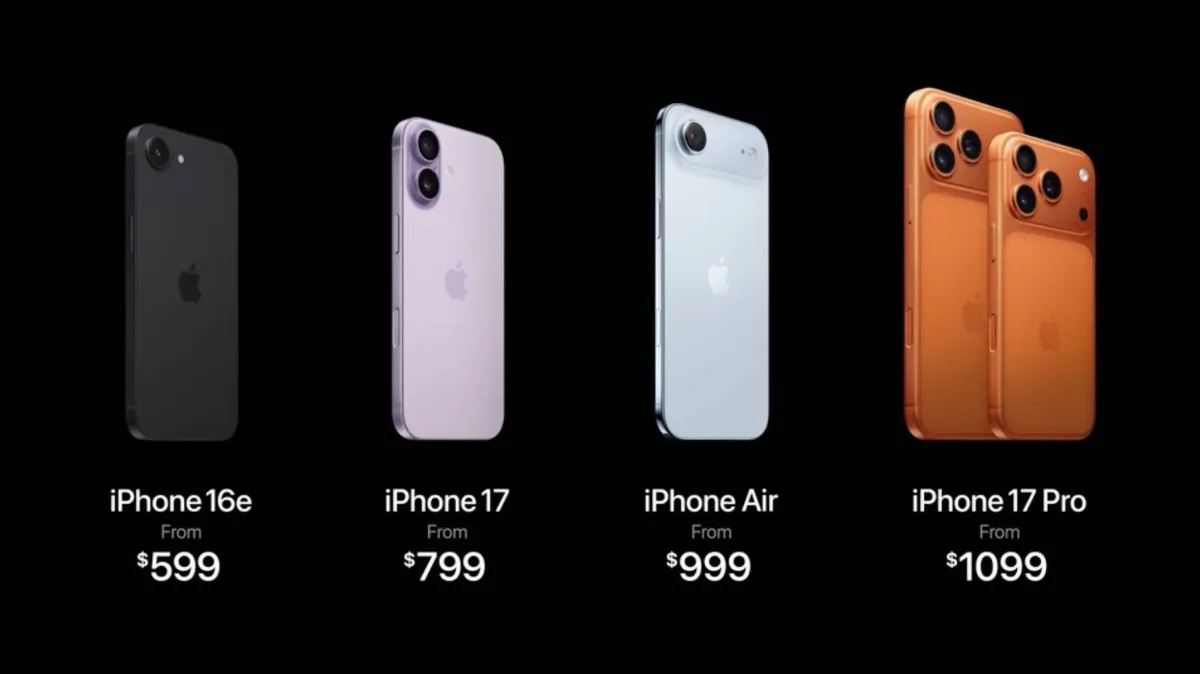
- iPhone 17e: The entry-level model starting at $599, offering exceptional value
- iPhone 17: The balanced flagship starting at $799, delivering performance and durability
- iPhone Air: The remarkably thin design starting at $999, resonating with style-conscious buyers
- iPhone 17 Pro and Pro Max: The ultimate cameras and performance starting at $1,099
CFO Kevan Parekh highlighted that the iPhone active install base grew to an all-time high during the quarter. With over half of iPhone purchasers in some markets coming from Android switchers, Apple continues to expand its ecosystem at the expense of competitors.
MacBook Neo and M5 Chips: The Best Mac Lineup Ever
While iPhone dominated the headlines, Apple's Mac business quietly delivered its best June quarter in history. Mac revenue surged 29% year-over-year to $10.4 billion, driven by the incredible strength of the latest lineup featuring the all-new MacBook Neo and updated MacBook Pro models powered by M5, M5 Pro, and M5 Max chips.
According to IDC, Apple gained share globally in the PC market. The company set a June quarter revenue record in developed markets and an all-time record in emerging markets, with particular strength in Greater China. Mac also achieved all-time records for both upgraders and customers new to the product — including in the US, China Mainland, and India.
What makes the Mac story particularly compelling for long-term investors is its positioning as an AI powerhouse. Apple silicon delivers outstanding power-efficient performance and massive memory bandwidth, making Macs the go-to choice for AI development and creative workflows. As Cook noted, customers are increasingly deploying clusters of Mac Studio systems to run frontier-class models locally — a trend that could drive sustained enterprise demand.
Interestingly, in the US education market, about half of MacBook Neo large purchases displaced Windows and Chromebook devices — a clear sign that Apple's value proposition is resonating with institutional buyers who have historically been price-sensitive.
Services: The $30.7 Billion Cash Cow Keeps Growing
Apple's services business — the high-margin engine that has transformed the company's profitability profile — delivered yet another record quarter. Services revenue reached $30.7 billion, up 12% year-over-year and setting a June quarter record despite significant sequential foreign exchange headwinds.
The services segment now accounts for roughly 28% of total revenue but an even larger share of profits, thanks to its industry-leading gross margin of 75.6%. Apple set records in every services category during the quarter, including:
- All-time records: Cloud services and payment services
- June quarter records: Advertising, App Store, AppleCare, Apple Music, and Apple TV+
- Paid subscriptions: Surpassed 1.5 billion globally
- Transacting and paid accounts: Both reached all-time highs with double-digit growth in emerging markets
Apple TV+ continues to gain cultural relevance. The streaming service earned the industry's top honors this year, adding Tony Awards to its collection of Emmy, Grammy, and Oscar wins — reaching that milestone faster than any streamer in history. With returning favorites like Ted Lasso (back for season four) and new releases like Widow's Bay, the content pipeline remains strong.
For American investors, the services business represents the ultimate recurring revenue model. With 2.5 billion active devices in use worldwide, Apple has an unparalleled distribution platform for subscription services, advertising, and financial products. Each new iPhone sale is not just a hardware transaction — it is the beginning of a multi-year services relationship.
Siri AI: The WWDC 2026 Bet That Could Change Everything
Perhaps the most important development for Apple's long-term future came not from the earnings report itself, but from the WWDC 2026 keynote that preceded it. At the developer conference, Apple unveiled the all-new Siri AI — a completely reimagined version of its voice assistant that is profoundly capable, deeply personal, and integrated seamlessly across Apple's platforms.
CEO Tim Cook described it as a product that "underscores our philosophy that building AI that is private and based on personal context can change how users find information and get things done with our products in a way that truly enriches their lives."
The early reviews from developers and public beta users have been phenomenal. Unlike competitors who rely on cloud-based AI that raises privacy concerns, Apple's approach processes personal data on-device using the A19 and A19 Pro chips in the iPhone 17 lineup. This privacy-first positioning resonates strongly with consumers and could become a meaningful differentiator as AI becomes central to the smartphone experience.
The Siri AI rollout is still in its early stages, with more work required in the coming months. But if Apple can deliver on its promise of a truly intelligent, private, and context-aware assistant, it could drive a massive upgrade cycle among the hundreds of millions of iPhone users who have been holding onto older devices.

Why the Stock Dropped After Earnings — And Why It Is Bouncing Back
Despite the blowout quarter, Apple stock fell sharply in the days following the July 30 report. Shares dropped from $333.43 on earnings day to as low as $302.94 on August 17 — a decline of roughly 9% in less than three weeks. For investors watching their portfolios, the move was confusing and frustrating.
The sell-off was driven by two main factors. First, management's guidance for the September quarter called for revenue growth of just 9% to 11% — a noticeable deceleration from the 16% growth delivered in Q3. CFO Parekh explained that the slowdown is primarily due to foreign exchange headwinds (expected to reduce growth by roughly 2.5 percentage points) and significantly increased supply constraints affecting iPhone, Mac, and iPad.
Second, gross margin guidance of 47% to 48% (excluding tariff refund benefits) represented a sequential decline from the 50.1% reported in Q3. The compression is driven by rising memory costs, which are impacting the entire semiconductor industry. While Apple is partially offsetting these costs through inventory management and component cost reductions, margins are facing near-term pressure.
However, the August rebound to $319 suggests that institutional investors are looking through these temporary headwinds. The supply constraints are a function of overwhelming demand — a high-class problem. The FX headwinds are external and transitory. And the memory cost pressures are industry-wide, not unique to Apple. For long-term holders, the underlying business momentum remains exceptionally strong.
Where AAPL Stands Now: Key Metrics
As of the August 28 close, here is the complete picture for Apple shareholders:
- Current Price: $319.70 (+1.63%)
- Previous Close: $314.58
- Day's Range: $315.40 - $320.73
- 52-Week Range: ~$245 - $334.75
- Market Cap: ~$4.85 Trillion
- P/E Ratio (TTM): ~32x
- EPS (TTM): ~$9.95
- Dividend: $0.27 quarterly (0.85% yield)
- Volume: ~39 million
- Average Volume: ~55 million
- Cash and Securities: $147 billion
- Total Debt: $84 billion
Apple ended the quarter with a fortress balance sheet: $147 billion in cash and marketable securities against $84 billion in total debt. During the quarter, the company returned $33 billion to shareholders through $4 billion in dividends and $25.8 billion in share repurchases. The board also declared a quarterly dividend of $0.27 per share, payable on August 13, 2026.
Technical Analysis: Can AAPL Reclaim $333?
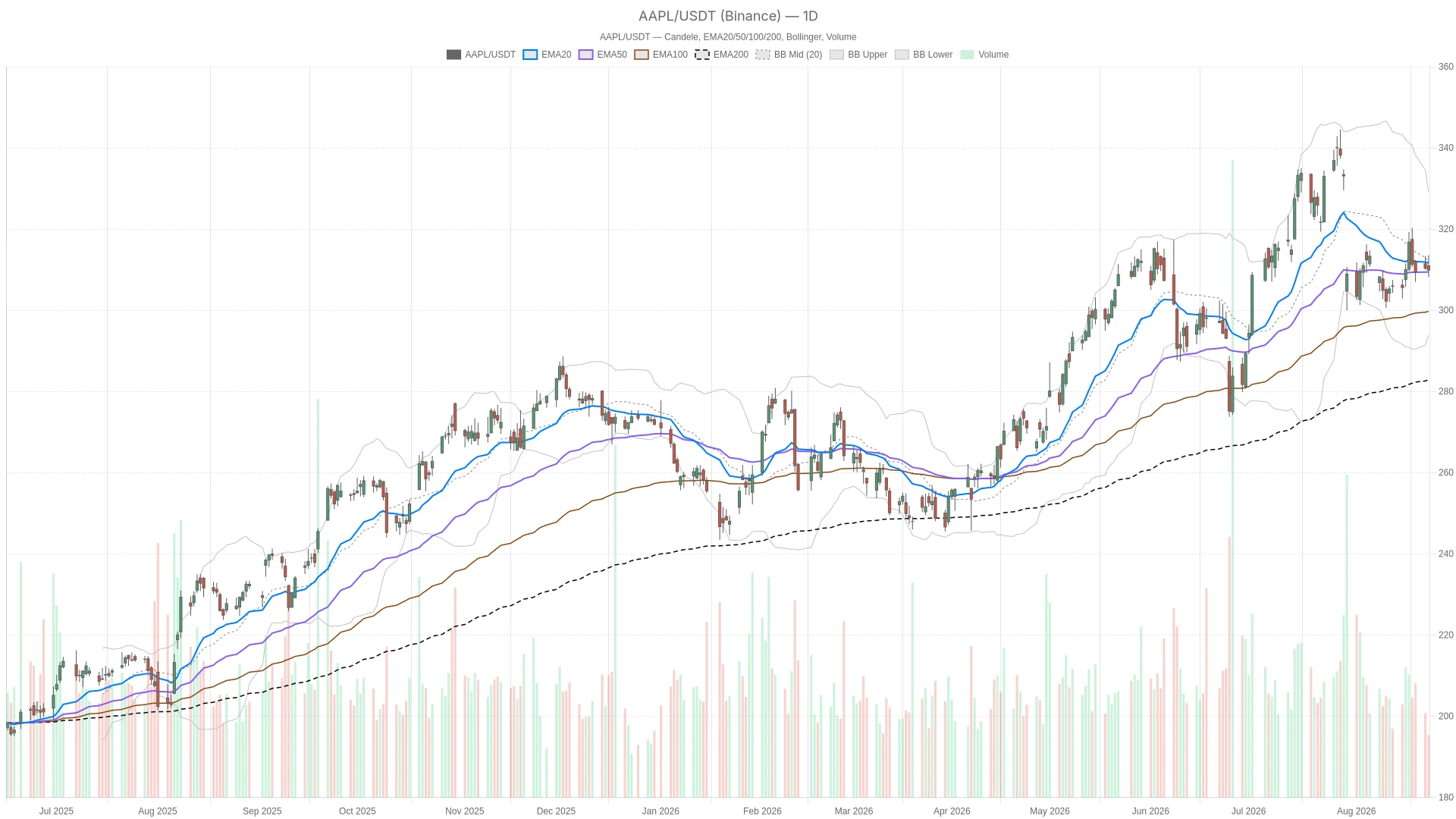
From a technical standpoint, Apple stock is in a recovery phase after the sharp post-earnings decline. The daily chart shows AAPL bouncing off the $305 support zone and reclaiming its 50-period EMA. Key levels US traders are monitoring:
- Immediate Resistance: $320 (psychological) and $325 (prior consolidation)
- Major Resistance: $333.43 (earnings day high) and $334.75 (52-week high)
- Support: $314 (recent lows) and $310 (August support zone)
- Breakdown Risk: Below $305 could open the door to $300 or lower
The MACD on the daily chart is showing early signs of a bullish crossover after the August washout, while the stock's beta of approximately 1.0 means it moves roughly in line with the broader market. Volume has been relatively light during the recovery at around 39 million shares — below the 55 million average — suggesting that the rebound may have further room to run as institutional investors re-enter positions.
The September Quarter: What to Watch
Apple's fiscal fourth quarter — the September quarter that includes the crucial back-to-school season and early holiday demand — will be the next major catalyst. Management guided for total revenue growth of 9% to 11%, with iPhone revenue growing in the mid-teens despite supply constraints.
Key variables that will determine whether Apple hits or exceeds guidance:
- Supply constraints: Management expects these to increase significantly in Q4, potentially limiting iPhone, Mac, and iPad availability
- Foreign exchange: The strong US dollar is expected to create a 2.5 percentage point headwind to year-over-year growth
- Services momentum: Apple expects services growth to be largely similar to Q3 after adjusting for FX impacts
- Gross margins: Guided to 47-48%, down from 50.1% in Q3, primarily due to memory cost increases
For investors, the supply constraints are a double-edged sword. In the short term, they limit revenue recognition. In the medium term, they suggest demand is outpacing supply — a bullish signal for future quarters once capacity catches up.
Frequently Asked Questions
What is Apple's stock price today?
As of August 28, 2026, Apple (AAPL) closed at $319.70, up $5.12 (+1.63%). The stock had previously closed at $314.58.
What were Apple's Q3 FY2026 earnings?
Apple reported revenue of $109.4 billion (up 16% YoY) and diluted EPS of $2.02 (up 29% YoY). iPhone revenue grew 22% to $54.3B, Mac revenue grew 29% to $10.4B, and Services reached $30.7B (up 12%).
Why did Apple stock drop after earnings?
AAPL fell from $333 to around $303 due to conservative Q4 guidance (9-11% revenue growth), expected gross margin compression (47-48%), and concerns about supply constraints affecting iPhone, Mac, and iPad availability.
What is Siri AI and when will it launch?
Siri AI is Apple's completely reimagined voice assistant unveiled at WWDC 2026. It is profoundly capable, deeply personal, and processes data on-device for privacy. It is currently in developer and public beta, with broader rollout ongoing.
Is Apple stock a buy at $319?
Wall Street remains overwhelmingly bullish on Apple. The company trades at roughly 32x trailing earnings, generates massive cash flow, and has a 2.5 billion device installed base. However, near-term headwinds including supply constraints and FX pressures create uncertainty.
When is Apple's next earnings report?
Apple is expected to report fiscal Q4 2026 earnings in late October 2026, covering the July-September period that includes the back-to-school season and early holiday demand.
Bottom Line for US Investors
Apple at $319 is a classic example of a great company experiencing temporary stock price volatility. The underlying business has never been stronger: record revenue, booming iPhone 17 sales, a services business generating $30+ billion per quarter at 75% margins, and a 2.5 billion device installed base that creates unparalleled ecosystem lock-in.
The post-earnings sell-off was driven by legitimate near-term concerns — supply constraints, FX headwinds, and memory cost inflation — but none of these factors challenge Apple's long-term competitive position. In fact, the supply constraints are evidence of demand exceeding expectations, which is ultimately bullish.
For American investors with a multi-year time horizon, Apple remains a cornerstone holding. The company generates enough cash to fund massive R&D investments, return $33 billion per quarter to shareholders, and maintain a $147 billion cash hoard — all while growing revenue at double-digit rates. The launch of Siri AI and the ongoing iPhone 17 supercycle provide clear catalysts for the next 12 to 18 months.
The path back to $333 and beyond may not be immediate. September quarter guidance was conservative, and macroeconomic headwinds remain. But for investors who have watched Apple navigate countless cycles over the past two decades, the playbook is familiar: buy the dip, hold through the turbulence, and let the world's most valuable company compound your wealth.
Are you buying AAPL at $319 or waiting for a pullback below $310? Share your strategy in the comments below.
Topics: Apple Stock AAPL, Apple Stock Price Today, AAPL Stock Analysis, Apple Earnings Q3 2026, iPhone 17 Supercycle, Siri AI, Apple Services Revenue, Tim Cook, Tech Stocks, NASDAQ AAPL, Investing, WWDC 2026


Comments
Post a Comment